Table of Contents
Crawl Space Humidity in Spring: What Is Happening Below Your Home
By late April in the Triangle, something shifts below most homes with vented crawl spaces. Outdoor temperatures warm up, humidity begins climbing, and the air flowing through foundation vents carries significantly more moisture than it did in January. Most homeowners notice it first as a musty smell when the air conditioner runs for the first time in the season.
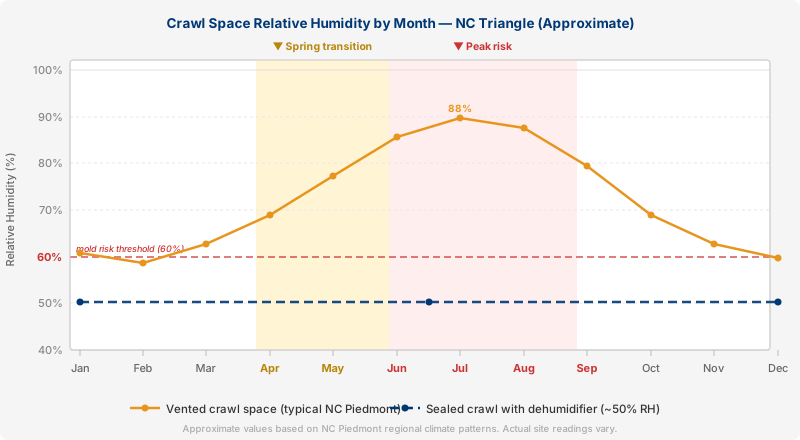
In North Carolina’s Piedmont climate, vented crawl spaces routinely cross the threshold for elevated mold and wood rot risk in April and May. That timing is not random. It follows a predictable pattern: outdoor dew points rise faster than the crawl space warms up, and the combination creates conditions for condensation and moisture accumulation inside the foundation.
This post explains the mechanism, what to look for on a basic self-check, and what the numbers mean so you can decide whether to call anyone.
Why Spring Is the Turning Point for Crawl Space Humidity
A crawl space is a below-grade cavity with cool surfaces. In winter, the soil, foundation walls, and any ductwork inside stay cool — typically in the 48–58°F range for most of Wake County. Outdoor air entering through foundation vents is also cool and carries relatively little moisture, so winter crawl space humidity in NC stays in a manageable range for most homes.
Spring changes the equation. As outdoor temperatures warm from March into May, the air carries substantially more water vapor. By mid-April, the outdoor dew point in the Triangle typically climbs into the upper 40s (°F). By May, it regularly reaches the upper 50s. The crawl space surfaces — floor, foundation walls, ductwork — are still cool from winter. When warm, humid outdoor air enters through foundation vents and meets those cooler surfaces, moisture condenses. The same mechanism that makes a cold glass sweat on a warm afternoon plays out beneath your house.
The effect intensifies when the air conditioner first starts running. Ductwork running through the crawl space gets cooled by the refrigerant to 55°F or below. Outdoor dew points are now 55–60°F. The duct surface is at or below the dew point. Condensation forms directly on the metal.
This is the spring trigger. It does not require summer humidity levels. It happens every April and May across most Triangle homes with vented crawl spaces.
How Crawl Space Air Reaches the Rooms You Live In
Crawl space moisture does not stay below the floor. Warm air naturally rises through a home by a mechanism called the stack effect. As conditioned air escapes upward through gaps around light fixtures, plumbing penetrations, and attic hatches, replacement air is drawn in from below through the crawl space.
In a home with a vented crawl, this means whatever humidity, mold spores, or musty odors exist below the floor circulate upward into the living space throughout the day. Spring is when this flow first carries elevated moisture load into the house after a drier winter. Homeowners with allergies or asthma sometimes notice worsening indoor symptoms in April and May before they ever look at the crawl.
For more on the sealed versus vented distinction and why it matters specifically in the NC Piedmont, the sealed vs vented crawl space guide covers the building science in detail.
Signs Homeowners Notice First in Spring
The spring transition does not always announce itself with visible mold or standing water. Early signals are usually subtle:
- A musty or earthy smell when the AC first cycles on, often lasting only a minute before duct air washes it through
- Increased allergy or respiratory irritation indoors during the first warm weeks of spring, especially on first-floor rooms
- Condensation on cold-water supply pipes or on the surface of HVAC ductwork visible through the crawl access
- A damp or clammy feel at floor level in first-floor rooms on warm afternoons
- Moisture visible on top of the vapor barrier if your crawl space has one
Any one of these warrants a closer look. Two or more together means a check is overdue.
A 4-Step Check Before Calling Anyone
You do not need professional tools to get useful information about your crawl space. This takes about 15 minutes:
Step 1: Smell test at the access opening. Open the crawl space hatch and stand at the opening before entering. A strong earthy or musty odor is a meaningful signal. No smell, or only a faint soil smell, is more reassuring.
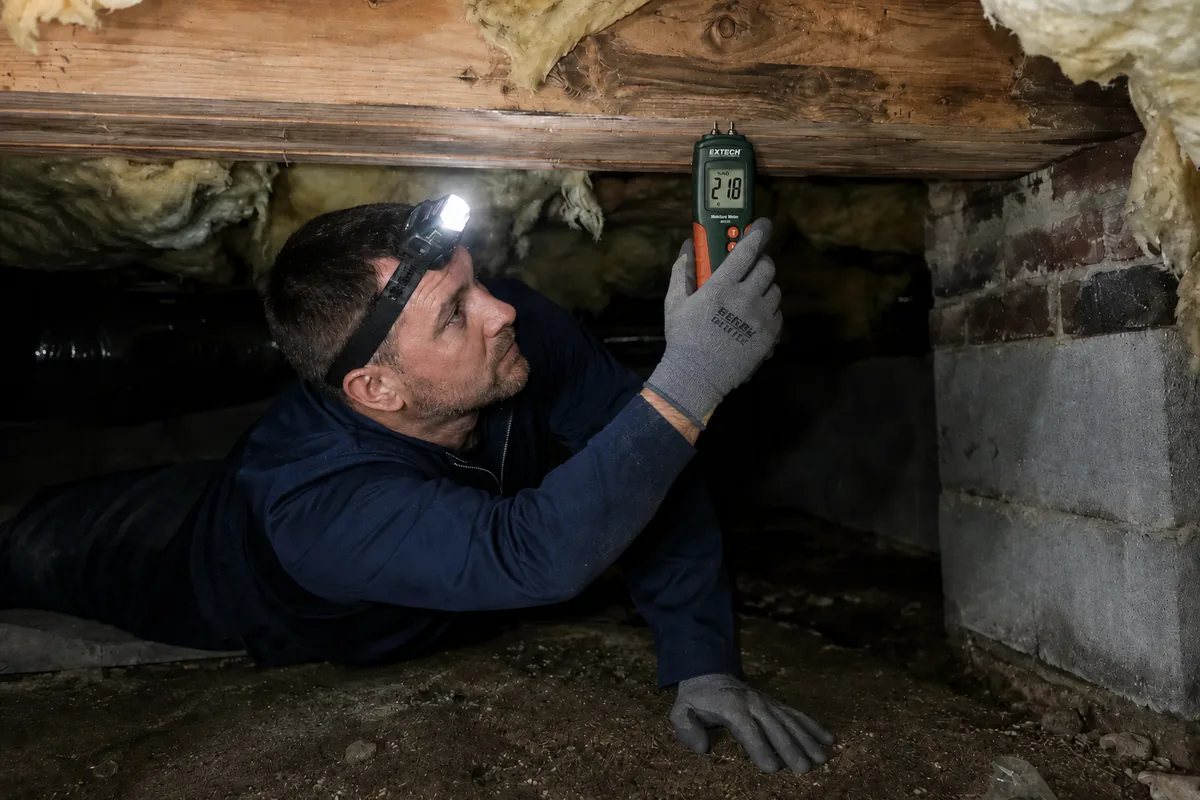
Step 2: Look at the ductwork and cold-water pipes. If you are comfortable crawling in (bring a headlamp, wear old clothes), look closely at any metal ductwork near the foundation vents. Water droplets or moisture streaking down the sides means the dew point mechanism is already active. Check cold-water supply lines for the same.
Step 3: Check the vapor barrier if there is one. Look at the surface of any plastic sheeting on the crawl floor. Moisture pooling on top of the barrier means water is moving upward through the soil. Tears, gaps, or sections pulled away from the foundation walls reduce protection significantly.
Step 4: Place a humidity monitor for 24 hours. A basic hygrometer from a hardware store (typically $15–$30) placed in the crawl space gives you a reliable ambient reading. Below 55% in April is reasonable. Between 55–65% is worth watching as summer approaches. Above 65% in April means the space is already in elevated-risk territory and will be substantially worse by July.
What Your Readings Mean
If you have a hygrometer reading from your crawl space, here is a practical interpretation for a vented space in the Triangle during spring:
- Below 55% RH: Reasonable for April or May. Monitor it monthly as summer humidity rises.
- 55–65% RH: Elevated and likely to climb further. A sealed crawl space with a dehumidifier would hold this space at 45–50%. Worth addressing before peak summer heat.
- 65–75% RH: Above the threshold where mold risk becomes meaningful on wood surfaces. If you are here in April, expect readings above 80% by July in a vented space.
- Above 75% RH: An active moisture problem. Mold growth is likely present somewhere in the space, whether visible or not.
These are ambient air readings. Humidity at the crawl floor surface or against the foundation walls is typically higher than the ambient air reading.
What to Do If Crawl Space Humidity Is High
For most Triangle homes, a reading above 65% in spring warrants action before summer. The options range from targeted to permanent:
A crawl space dehumidifier — a purpose-built unit like the AprilAire E70W or E100W mounted in the crawl and plumbed to a condensate drain — can manage humidity even in a vented crawl space. It works harder and less efficiently than it would in a sealed space because it continuously pulls against the open vents, but it can bring relative humidity down to a workable level. Peak Energy, Inc. in Holly Springs, NC installs and services crawl space dehumidifiers throughout Wake County. See the crawl space dehumidifiers page for details on sizing and what the installation involves.
Full crawl space encapsulation is the long-term solution. Sealing the foundation vents, covering the floor and walls with a heavy vapor barrier, and installing a properly sized dehumidifier removes the vented crawl space entirely and replaces it with a controlled environment. After crawl space encapsulation, a well-designed sealed crawl maintains 45–55% RH year-round, including through Triangle summers. A typical encapsulation project in Wake County averages an estimated $7,500–$15,000, depending on crawl size, existing conditions, and dehumidifier selection. The full cost breakdown explains what drives the price.
For homeowners in Holly Springs, Fuquay-Varina, Apex, Cary, and surrounding Wake County communities, Peak Energy, Inc. provides free crawl space assessments. We measure humidity, inspect visible conditions, and give you a plain read on what the space needs — with no obligation to move forward.
Frequently Asked Questions
What humidity level is too high in a crawl space?
For most wood-framed crawl spaces, sustained relative humidity above 65% creates elevated mold and wood rot risk. Above 70% warrants prompt attention. The target range for a well-managed crawl space is 40–55% RH. If you are measuring above 65% in spring, the space needs humidity control before summer arrives.
Why does my crawl space smell musty only when the AC turns on?
When your air conditioner starts running, it creates negative pressure in the living space that draws air upward through gaps in the floor. That air comes from the crawl space. If the crawl has elevated humidity or early-stage mold, you will smell it in the house when the system kicks on — sometimes for the first time in spring. This is the stack effect, and it is one of the clearest early signals of a crawl space moisture problem.
Is spring or summer worse for crawl space humidity in NC?
Summer is worse in absolute terms — outdoor dew points peak in July and August, and a vented crawl space can reach 80–90% relative humidity for weeks at a time. But spring is when the problem begins and when catching it early can prevent the worst of the summer damage. Checking your crawl in April or May gives you time to act before conditions peak.
Can I fix crawl space humidity without full encapsulation?
A standalone crawl space dehumidifier can reduce relative humidity even in a vented crawl space, but it works against the open vents and runs constantly at higher operating cost. Full encapsulation — sealing the vents, covering the walls and floor with a vapor barrier, and adding a properly sized dehumidifier — is more effective and more efficient long-term. For mild cases where the crawl is otherwise in good shape, a dehumidifier alone is a reasonable first step. For most older homes in the Triangle with vented crawl spaces, the long-term answer is encapsulation.
Not sure what your crawl space needs?
Peak Energy provides free assessments across Wake County and the Triangle. We will tell you what we see and what, if anything, needs to be done.
Serving Holly Springs, Fuquay-Varina, Apex, Cary, Raleigh, Garner, and the broader Triangle region.