Table of Contents
Duct Leakage Test Results Explained: What Your CFM25 Number Means
A duct leakage test may report total duct leakage, duct leakage to the outside, or both, each measured in CFM25 per 100 square feet of conditioned floor area. If you just received results from a test on a new home or an existing one, here is how to read those numbers, what North Carolina code requires, and what to do next if a result comes back higher than it should.
The short answer for new construction in NC: total duct leakage must be 5 CFM25/100sf or less, and duct leakage to the outside must be 4 CFM25/100sf or less, to meet the 2018 NC Energy Conservation Code. For existing homes there is no code threshold, but ducts running conditioned air into an attic or crawl space instead of the living area show up directly in comfort and utility bills.
What the Test Actually Measures
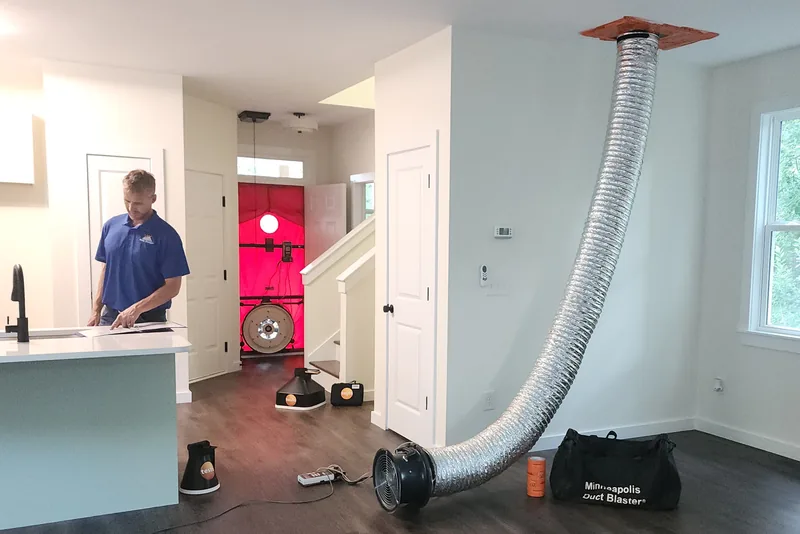
A duct leakage test uses a calibrated fan called a duct blaster, sealed directly to a return grille or connected through a temporary duct collar. The fan pressurizes the duct system to 25 pascals, then measures how much air it takes to hold that pressure. Whatever the fan has to supply to maintain 25 pascals is air leaking out of the ducts somewhere between the air handler and the registers.
That airflow gets normalized against the home’s conditioned floor area and expressed as CFM25 per 100 square feet, so a small house and a large house can be compared on the same scale. The test works on the same principle as a blower door test: pressurize, measure the airflow it takes to hold that pressure, and use the number to find where air is escaping.
Total duct leakage counts every leak in the system, including ones inside conditioned space. A leaky joint in a supply trunk running through a conditioned basement still loses air, but that air stays in the house. Duct leakage to the outside only counts leaks that dump conditioned air into an unconditioned space, an attic, a vented crawl space, or a garage, where it is gone for good. NC code caps both numbers separately because a duct system can pass one test and fail the other.
What NC Code Requires
The 2018 North Carolina Energy Conservation Code (NCECC) sets two separate duct leakage limits for new residential construction:
- Total duct leakage: 5 CFM25/100sf of conditioned floor area or less
- Duct leakage to the outside: 4 CFM25/100sf or less
Both numbers apply to the finished, conditioned floor area of the house, not the attic or crawl space where the ducts run. The 2018 NCECC includes exceptions: duct systems located entirely within the thermal envelope, partial replacement work that does not constitute a new system, and complete systems serving 750 square feet or less are exempt from the duct leakage testing requirement. The test can happen at rough-in, before insulation and drywall cover the duct system, or as a final test on the completed home. Rough-in testing lets a contractor find and fix leaks while everything is still exposed. In our experience testing Triangle new construction, rough-in is the more common choice: access is easier and sealing goes faster before insulation goes in.
What a Failing Result Means for New Construction
A result above either threshold does not mean the ductwork needs to be replaced. In most cases, a handful of specific connections were not sealed with mastic, or the wrong tape was used.
Common failure points on Triangle new construction:
- Supply boots where flex duct connects to the register, especially in vented crawl spaces or attics
- Return plenums built from framing cavities (panned returns) instead of dedicated metal or duct board
- Trunk-and-branch takeoffs that were never properly sealed with duct mastic or UL 181 tape
- Disconnected or crushed flex duct in the attic, often from foot traffic during other trades’ work
- Air handler cabinet seams and the filter access panel
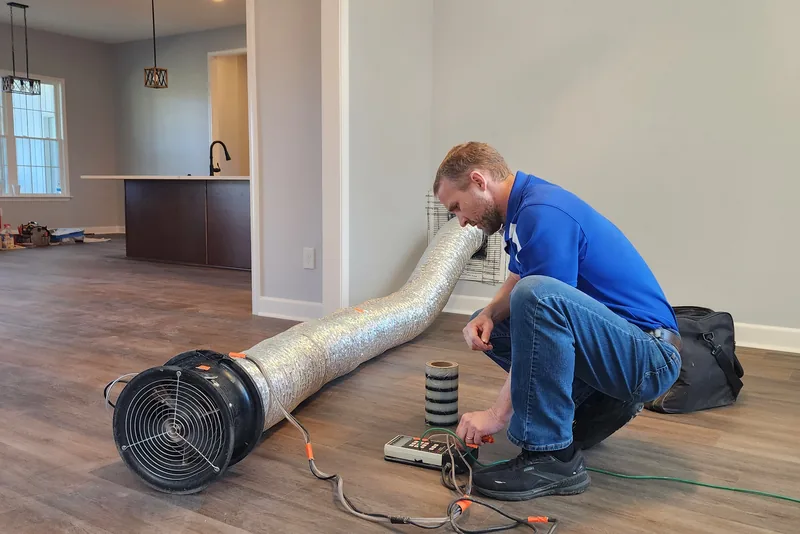
Peak Energy, Inc. performs duct leakage testing across Holly Springs, Raleigh, Fuquay-Varina, and Wake County. When a system fails, the approach is to pressurize the ducts, walk the attic and crawl space to find where air is escaping, seal those points with mastic, and retest. Most systems that fail by a moderate margin reach compliance in a few hours of targeted sealing.
A written test result is provided for code documentation on passing systems.
What the Result Means for an Existing Home
Existing homes are not subject to the 5 CFM25/100sf and 4 CFM25/100sf code limits. Those apply only to new construction permitted under the 2018 NCECC. But the numbers still tell you something.
An existing system testing near the code threshold is in reasonable shape. A system leaking well beyond it, common in Wake County homes built before 2009 with ducts running through a vented crawl space or unconditioned attic, is losing a meaningful share of every heating and cooling cycle before the air reaches a single room.
For older homes in Cary, Raleigh, and Garner with ducts in an unconditioned attic, leakage to the outside is usually the bigger problem than total leakage. That is the air that never makes it into the house at all. Duct leakage is one of the checks covered in what a home energy audit finds in a Triangle home: the duct blaster runs alongside the blower door and thermal imaging so leakage gets measured, not guessed at.
CFM25 and Your Energy Bills
Duct leakage costs a house in two directions. Supply leaks push conditioned air into the attic or crawl space, air the system already spent energy heating or cooling, before it reaches a register. Return leaks pull unconditioned air from the same spaces back into the system, which the equipment then has to recondition from scratch.
In the Triangle’s climate, return leaks in a vented crawl space or attic are the more expensive failure mode in summer. That air often carries the outdoor humidity load along with it, so the system is not just cooling extra air, it is also wringing extra moisture out of it before the house feels comfortable. ENERGY STAR estimates that in a typical home, 20–30% of the air moving through the duct system is lost to leaks, holes, and poorly connected ducts before it reaches the living space.
A home energy audit pairs the duct blaster test with a blower door test and thermal imaging to see whether duct leakage or envelope air leakage is the bigger driver of a specific home’s energy bill, so any sealing work goes where it actually pays off. The step-by-step audit process walks through how the two tests fit together on a single visit.
Duct Leakage Test Cost in NC
Duct leakage testing is typically $250 for an average size HVAC system in a local home. Outside duct leakage testing (which measures only leaks that dump conditioned air into unconditioned space, and requires a blower door in addition to the duct blaster) is an additional $150, bringing the combined package to $400. For builders testing multiple systems or multiple homes in the same community, bundle pricing applies.
Peak Energy, Inc. issues a written test result on passing systems and provides retesting if the first attempt does not meet the 5 CFM25/100sf and 4 CFM25/100sf thresholds.
For homeowners, duct leakage testing is a common add-on to a home energy audit. The audit itself runs an estimated $475–$650 and covers the blower door test, thermal imaging, and an on-site walkthrough of findings. Duct leakage testing is not part of that base fee. It is priced separately, an estimated $200 per average size HVAC system when added to an audit, and folded into the same visit rather than a second trip.
FAQ
What is a passing duct leakage test result in NC?
For new construction in North Carolina, the 2018 NC Energy Conservation Code requires total duct leakage of 5 CFM25/100sf or less, and duct leakage to the outside of 4 CFM25/100sf or less. Existing homes are not held to either threshold, but systems testing well above those numbers typically have meaningful sealing opportunities.
What happens if a new home fails the duct leakage test in NC?
If a new construction duct system tests above 5 CFM25/100sf total or 4 CFM25/100sf to the outside, it does not meet the NC Energy Conservation Code. The contractor has to seal the leakage paths, typically supply boots, panned returns, or trunk connections, and retest before the system passes. Peak Energy, Inc. provides a written result on passing systems. Most failures on first attempt trace to a small number of connections that can be sealed with mastic in a few hours.
How much does a duct leakage test cost in NC?
Duct leakage testing is typically $250 for an average size HVAC system in a local home. Outside duct leakage testing, which requires a blower door in addition to the duct blaster, is an additional $150, bringing the combined package to $400. Peak Energy, Inc. provides a written test result on passing systems. Bundle pricing is available for builders testing multiple systems or homes.
Schedule a duct leakage test
Need a duct leakage test in Wake County?
Peak Energy, Inc. provides duct leakage testing for new construction code compliance and home energy audits across Wake County and the Triangle. Written test result on passing systems. Bundle pricing for builders.
Serving Holly Springs, Fuquay-Varina, Apex, Cary, Raleigh, Garner, and the broader Triangle region.