Table of Contents
Key takeaway: A blower door test and a home energy audit both use the same calibrated fan, but they’re different services. A blower door test gives you a single number: how leaky your house is. A home energy audit gives you that number plus a plan. Builders usually need the test. Homeowners usually need the audit.
Homeowners in the Triangle hear “blower door test” and “home energy audit” used as if they’re the same thing. They’re not. They share equipment, but the deliverable is different, and so is the right one to buy.
Peak Energy, Inc. in Holly Springs, NC performs both. We test new homes for NC code compliance, and we run full energy audits for Wake County homeowners trying to fix comfort or energy bill problems. This post explains the difference so you know which one fits what you’re trying to accomplish.
The Short Version
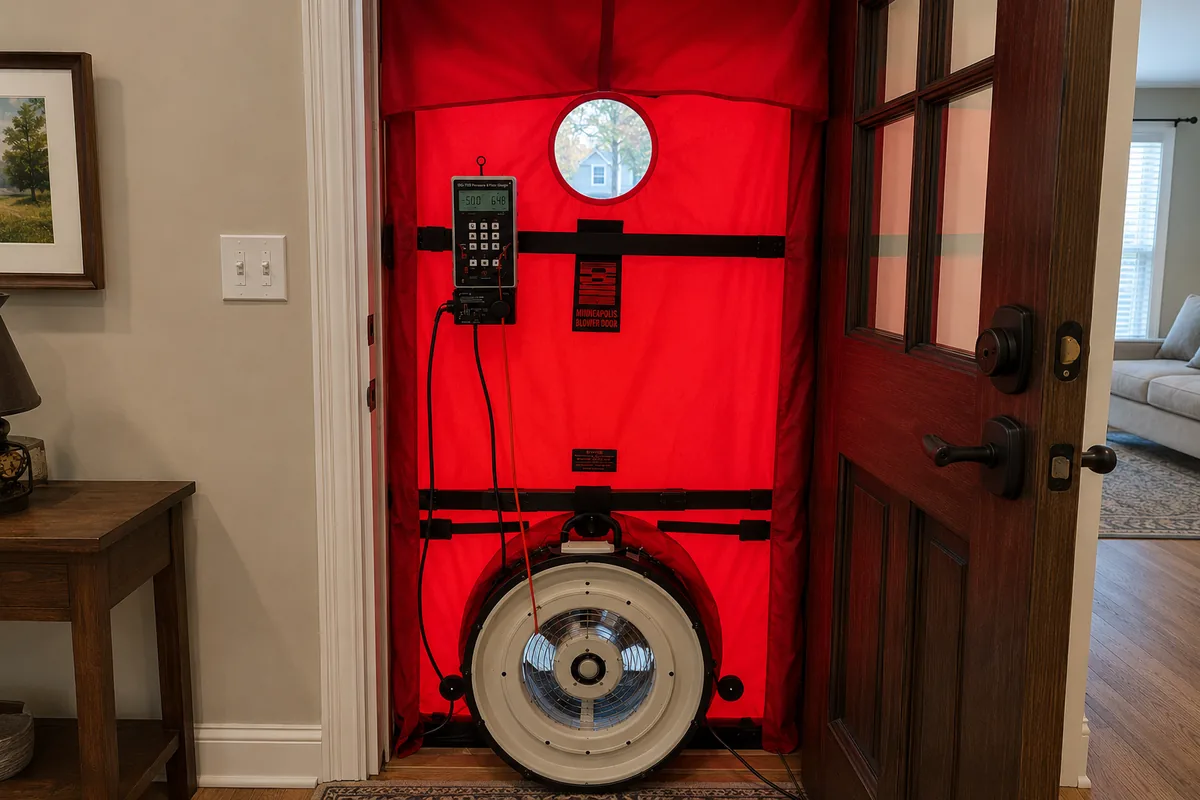
A blower door test is a diagnostic measurement. A trained technician seals a calibrated fan into your front door, depressurizes the house to negative 50 pascals, and records how much air flows through the fan to maintain that pressure. The result, expressed as ACH50, tells you how leaky the building envelope is.
A home energy audit is a service package. It includes a blower door test, plus thermal imaging, duct leakage testing, an attic and crawl space inspection, and an on-site discussion of findings with the homeowner. The blower door is one of several tools.
The simplest way to say it: the blower door test is one of the instruments an audit uses. You can buy that instrument’s output on its own, or you can buy the full package the audit assembles around it.
What a Blower Door Test Actually Is
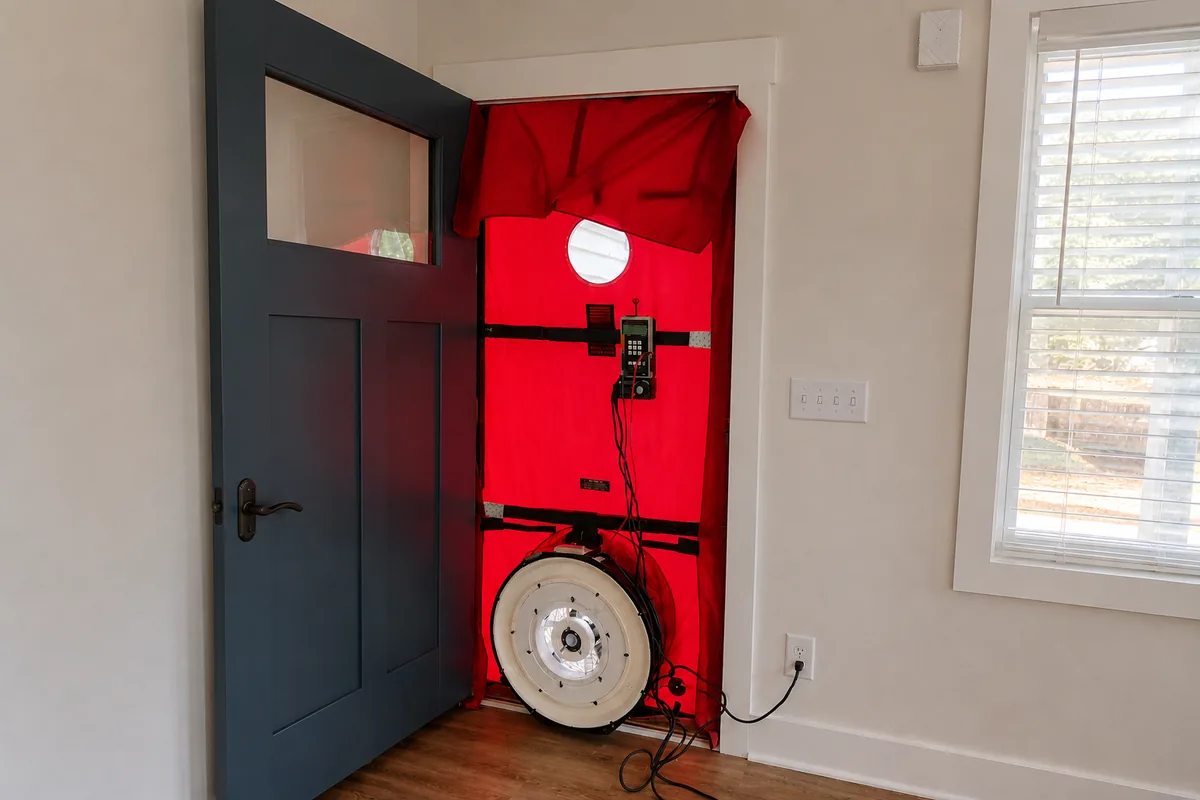
A blower door is a calibrated fan mounted inside an adjustable frame that seals to an exterior door opening. The technician closes all other exterior openings, turns off combustion appliances, and runs the fan to pull air out of the house. As the house depressurizes, outside air leaks in through every crack, gap, and penetration in the building envelope. The fan measures how much air it has to move to maintain a 50-pascal pressure difference between inside and outside.
That number (cubic feet per minute at 50 pascals, or CFM50) gets divided by the house’s volume to give you air changes per hour at 50 pascals, ACH50. That’s the standard metric for envelope tightness.
Setting up and running the test takes 60 to 90 minutes for a typical Wake County home. The technician records the result, prints a report, and leaves. If the customer is a builder satisfying NC code, the technician also fills out the NC Energy Efficiency Certificate, which goes inside the cabinet under the kitchen sink for the building inspector.
That’s the entire scope of a standalone blower door test. One number. One certificate. No recommendations on what to do next.

What a Home Energy Audit Actually Is
A home energy audit runs the blower door test as one step inside a longer diagnostic process. A typical audit visit lasts three to four hours and works through this sequence:
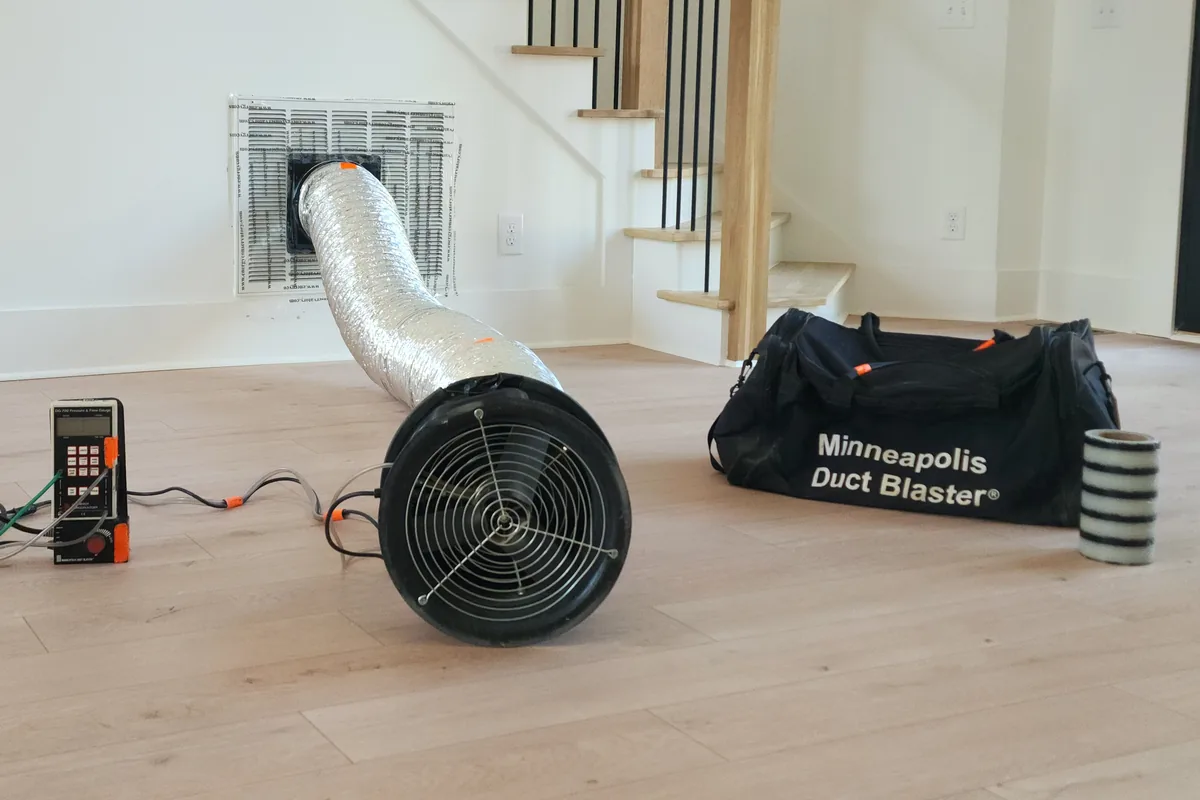
A pre-audit interview about comfort complaints, drafty rooms, equipment age, and 12 months of utility bills. Then a walkthrough of the attic, crawl space, mechanical systems, and main living area, with the technician taking notes on insulation depth, air sealing gaps, HVAC condition, and visible moisture. Then the blower door test, run alongside a thermal imaging scan of the envelope. Then a duct leakage test using a duct blaster to measure how much conditioned air escapes the duct system before it reaches the rooms. Finally, an on-site walkthrough of the findings with the homeowner, prioritizing recommended improvements by payback.
The blower door does double duty during an audit. The fan running on its own gives the ACH50 number, but it also depressurizes the house, which exaggerates every air leak in the envelope. Outdoor air rushes in through gaps that would be invisible under normal conditions, and that moving air carries the outdoor temperature with it. We walk the home with an infrared camera while the fan is running, and the leaks light up: cold streaks across the ceiling around recessed lights, warm bands along the rim joist, plumes around an attic hatch. That’s information you simply cannot get from the blower door number on its own, or from a thermal scan without the fan.
The trick is that thermal imaging needs a temperature difference between indoors and outdoors to work well. A 15°F differential between inside and outside is the practical minimum for sharp, decision-grade images. In the Triangle, that means winter and the hot edge of summer are the best windows. A mild May afternoon with 72°F indoors and 70°F outdoors will show very little, no matter how leaky the house is. We schedule around the weather when the homeowner has flexibility.
The deliverable is the walkthrough conversation, not a written report. The customer leaves knowing what’s wrong, what to fix first, and roughly what each fix will cost and return. For a deeper look at what each step actually looks like in practice, see what happens during a home energy audit in NC.
The blower door number is part of that conversation, but it’s not the point of the visit. The point is the prioritized list.
Side-by-Side Comparison
The two services share equipment but very little else.
| Detail | Standalone blower door test | Home energy audit |
|---|---|---|
| Primary audience | Builders, contractors, homeowners with a single envelope question | Homeowners trying to lower bills or fix comfort problems |
| Time on site | 60–90 minutes | 3–4 hours |
| Tests run | Blower door | Blower door, thermal imaging, duct leakage, attic and crawl inspection |
| Deliverable | ACH50 number, code certificate if applicable | On-site walkthrough of findings and prioritized improvements |
| NC code compliance | Yes, for new construction at ≤5 ACH50 | Not the purpose, though the blower door portion meets the standard |
| Typical use | Pass/fail on new construction, post-air-sealing verification | Diagnose why bills are high or rooms are uncomfortable |
| Cost in the Triangle | Starts at $200 (varies by location and scope) | $475–$650 (varies by location and scope) |
The audit is meaningfully more than the standalone test. The extra cost buys additional tools (a thermal camera, a duct blaster) plus the time to run them, interpret the findings across the whole house, and walk you through what to do next. You’re paying for a different scope of work, not the same test with a longer invoice.
When a Standalone Blower Door Test Is the Right Choice
A standalone test makes sense in a handful of clear cases.
New construction in NC. The 2018 NC Energy Conservation Code requires new homes to test at 5 ACH50 or better, or alternatively 0.30 CFM50 per square foot of surface area, under Section R402.4.2.2. Builders must produce a passing test before final occupancy. Peak Energy provides the test, the report, and the NC Energy Efficiency Certificate. For details on what builders need, see our blower door testing service page.
Post-air-sealing verification on an existing home. If you’ve spent money on rim-joist foam, attic air sealing, or window replacement and want to know whether the work moved the needle, a blower door test before-and-after gives you the answer in numbers, not promises.
Pre-purchase due diligence on an older home. A blower door test on a 1970s Cary ranch tells you how much air sealing work the home needs. That’s information you can use at the closing table, and it costs less than most home-inspection add-ons.
A single envelope question. Sometimes a homeowner already has a clear scope: they know they want to air-seal the attic and just want a number to track against. The test fits that.
What a standalone test does not do well is answer the question “why is my house uncomfortable” or “where is my biggest energy waste.” The blower door tells you about the envelope. It doesn’t tell you about the ductwork, the insulation depth, the crawl space, or the HVAC. If those are also in play (and in most older Triangle homes, they are), you want the audit.
When a Home Energy Audit Is the Right Choice
A home energy audit is the right call when the problem you’re solving is multi-cause.
High energy bills you can’t explain. If your Duke Energy bill has climbed and you can’t tell whether the cause is the attic, the crawl space, the HVAC, or duct leakage, the audit tests all of those in one visit. If you’re trying to figure out where to start, why your energy bill is high in NC covers the most common causes Triangle homeowners run into.
Persistent comfort problems. Cold floors in winter, hot upstairs in summer, one room that never feels right: these almost always trace to a combination of insulation, ductwork, and envelope issues. A single blower door number won’t sort that out. The audit will.
You’re planning multiple improvements and want to sequence them. Spending on the wrong improvement first is the most common waste of energy-retrofit money. The audit prioritizes by payback, so you spend on the duct sealing before the new windows, the attic insulation before the HVAC replacement, the crawl space encapsulation before the dehumidifier upgrade. Sequencing matters more than scope.
You want measurement-backed advice instead of a sales quote. A free in-home inspection from a contractor selling one specific service tends to recommend that service. An audit, by design, separates the diagnostic from the sale. The same technician may eventually do the work, but the recommendations come from the data.
Doesn’t an Audit Include a Blower Door Test?
Yes. This is where the naming confusion comes from. An audit includes a blower door test as one of its steps, so people sometimes refer to the audit itself as “a blower door test.” That conflation is fine in casual conversation but it costs people money when they go to buy.
Three useful clarifications.
If you buy a standalone blower door test and later decide you want the full audit, you’ve paid for an instrument output you would have gotten anyway. Decide first.
The blower door portion of an audit and a standalone blower door test are mechanically identical: same equipment, same procedure, same numbers. The difference is what surrounds the test, not the test itself.
For NC code compliance, you specifically need the standalone test product with the certificate. The audit’s blower door portion produces the same numbers but isn’t structured as a code-compliance deliverable. Builders should ask for the test by name.
NC-Specific Context: Code, Climate, and Cost
A few facts that matter for the Triangle.
Wake County sits in IECC Climate Zone 4A. Johnston County, where parts of Garner and Clayton reach, is in Climate Zone 3A. Both zones require new construction to meet ≤5 ACH50 or ≤0.30 CFM50 per square foot of surface area under the 2018 NC Energy Conservation Code Section R402.4.2.2.
Older Triangle homes test well above the code threshold. A 1970s–1980s Cary or Raleigh home with original construction often falls between 10 and 15 ACH50. A 1990s–2000s Holly Springs or Fuquay-Varina home typically falls between 6 and 10. A 2015-plus build tested at code typically falls between 3 and 5. These ranges are estimates from typical Wake County housing stock and vary house-by-house.
The Triangle climate compounds envelope leakage. From June through September, outdoor relative humidity in the Piedmont runs 70–90%. Every cubic foot of air your house pulls in during those months arrives loaded with moisture. The looser the envelope, the more your HVAC works on latent load instead of cooling air. Tight envelopes save real money in the Triangle for reasons that have less to do with temperature than humidity.
For builders satisfying both blower door and duct leakage requirements in one visit, the combined test runs around $400 (roughly $200 for the blower door, plus $200 for the duct leakage test) and produces both certificates. For more on the duct side, see duct leakage testing for NC builders.
Which to Choose: A Plain Decision Path
Two questions usually settle it.
Are you a builder, or a homeowner who needs a single number for a specific reason? Pick the standalone blower door test. You’ll get the number, the certificate, and you can go.
Are you a homeowner trying to fix something — bills, comfort, room imbalance, moisture, and you don’t already know exactly what’s causing it? Pick the home energy audit. The blower door number is in there, plus the rest of what you actually need.
If you’re not sure which describes you, the audit is the safer default. The cost difference is small and the diagnostic scope is much wider. A homeowner buying the standalone test alone will, in our experience, end up calling back for the audit within the year.
Cost Summary
A few practical numbers for the Triangle.
A standalone blower door test starts at $200 for a single-family home. Final price depends on location, house size and layout, and any additional options. A combined blower door plus duct leakage test, often what builders need, runs around $400, roughly $200 per test. A full home energy audit, which includes the blower door test as one of several diagnostics, runs $475–$650, with location, house size, and scope determining where your job falls in that range.
Add-on services (encapsulation, attic insulation, dehumidifier installation, duct sealing) are priced separately and depend on scope. A crawl space encapsulation in the Triangle averages an estimated $7,500–$15,000 depending on size and conditions. An attic insulation top-up to R-49 typically runs $2,500–$5,500 depending on existing R-value and square footage.
The audit doesn’t include the work itself. It tells you what work is worth doing.
Ready to Choose?
Peak Energy, Inc. in Holly Springs, NC performs both standalone blower door testing and full home energy audits across Wake County and the broader Triangle. We do the testing ourselves on calibrated equipment, and we walk through findings on-site with you the same day.
If you’re a builder needing NC code compliance testing, call (919) 567-5329 or ask about our blower door testing service. If you’re a homeowner trying to figure out where your home is losing energy, ask about a home energy audit on the same line.